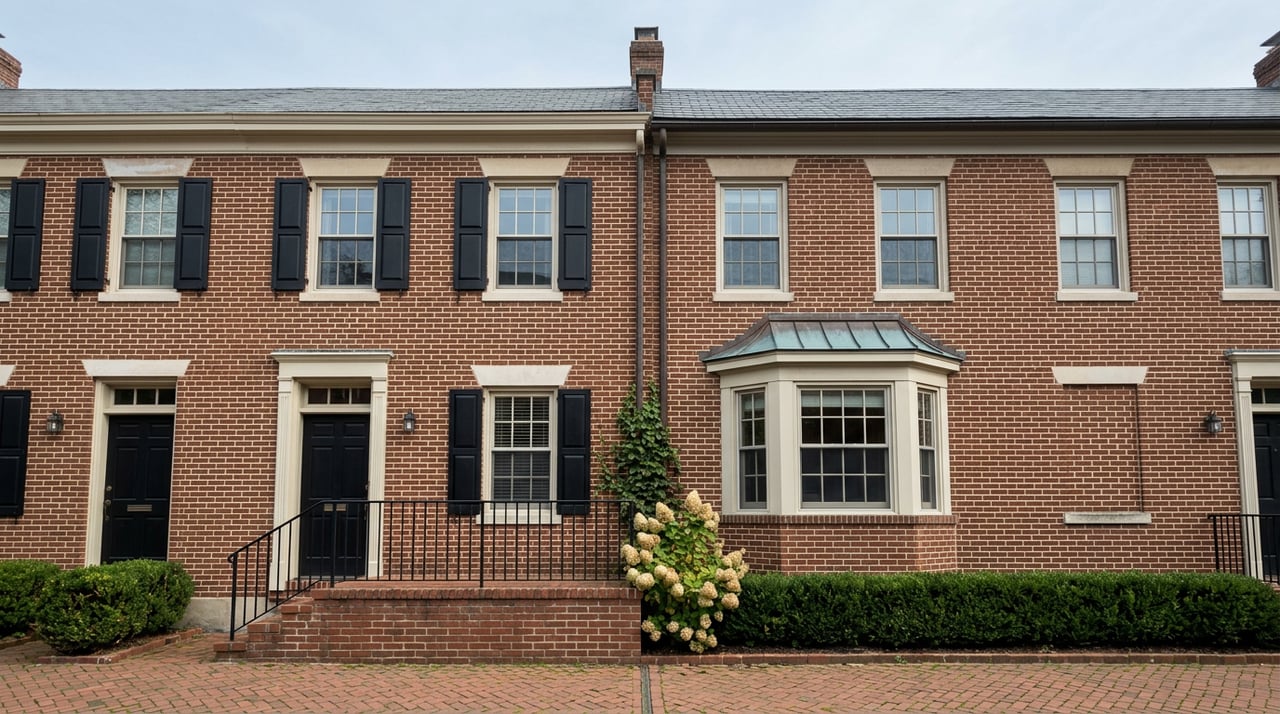
Walk down R Street between 37th and 39th and you'll see block after block of identical brick rowhouses, their proportions so consistent that the street reads like a single architectural statement rather than a collection of separate properties. These are Shannon & Luchs Colonial Revival rowhouses, roughly 450 of them, built between 1923 and 1928, with a smaller run of Cooley Brothers Tudor houses tucked onto T Street between 38th and 39th. It looks like the kind of neighborhood where every window replacement needs a permit hearing. It isn't.
Georgetown University borders Burleith along Reservoir Road and 35th Street. Glover-Archbold Park runs along its western edge at 38th and 39th, and the neighborhood's uniformity is no accident. But unlike Georgetown next door, or Kalorama a few miles east, Burleith has no historic district designation and no Historic Preservation Review Board oversight on what residents do to their facades. That absence isn't an oversight. It's the outcome of a deliberate, multi-year decision the neighborhood made for itself, and it changes what buying and renovating here actually looks like compared to its landmarked neighbors.
The Vote Nobody Outside Burleith Noticed
The Burleith Citizens Association, founded in January 1925, spent the better part of three years working through the historic designation question in the open. It started with a town hall on February 25, 2016, where Kim Williams from the DC Office of Historic Preservation and Paul DonVito from the neighboring Foxhall Village Historic District laid out what designation would mean in practice. By that September, the BCA board had tabled the idea to study alternatives, including zoning overlays and conservation districts, through a Neighborhood Study Group made up of homeowners on different sides of the question.
The debate didn't fade. A group called Friends of Burleith organized in favor of designation, and in May 2018 they brought John Sandor, president of the DC Preservation League, and DonVito back for a session at the Georgetown Neighborhood Library specifically on the permitting and cost implications of historic status. The BCA opened a survey to residents and owners on June 3, asking directly whether they wanted historic designation, and kept it running through September 3. While the question was still open, The Georgetowner ran a piece that July under the headline "Burleith Split on Historic Designation." On September 5, the BCA released the survey results, and the association's own summary is direct: the responses showed clear opposition.
That vote is the reason a rowhouse in Burleith and a nearly identical one in Georgetown or Kalorama sit under completely different regulatory regimes today, despite dating from the same architectural era and sharing the same red brick and Colonial Revival details.
What That Decision Actually Buys You
In DC's historic districts, exterior work triggers a formal review path before a building permit can even be filed. Depending on the district, that review runs through the citywide Historic Preservation Review Board or, in Georgetown's case, through the Old Georgetown Board, a separate review body with its own track record and expectations that contractors describe as distinct from standard citywide HPRB work. Either way, a homeowner planning anything visible from the street, a new roof deck, a rear addition, a porch rebuild, window replacement, or masonry repair, has to route the plan through a preservation body before the Department of Buildings will touch it.
None of that applies in Burleith.
| Historic Review Body | Exterior work requires board review | |
|---|---|---|
| Burleith | None | No. Goes straight to DC Department of Buildings |
| Georgetown | Old Georgetown Board | Yes, for exterior alterations, additions, and demolition |
| Kalorama Triangle / Sheridan-Kalorama | DC Historic Preservation Review Board | Yes, for facade changes, additions, roof decks visible from the street |
That's not a minor procedural difference. A rear addition, a new dormer, or a roof deck that would need conceptual approval and possibly a full HPRB hearing in Kalorama Triangle can move directly to permitting in Burleith. The same is true for the categories that most often trip up owners in landmarked districts elsewhere in the city: windows, doors, masonry, roofing, fences, retaining walls, sidewalks, and driveways. In Burleith, those are Department of Buildings matters, not preservation board matters.
For a buyer comparing a Burleith rowhouse to something similar in Georgetown or Kalorama, that's real money and real time. It's also worth being honest about what it doesn't protect. The BCA is a voluntary civic association, not a property manager, and there's no HOA and no legal mechanism forcing consistency. If a neighbor decides to replace original wood windows with vinyl or repoint brick with the wrong mortar, there's no board that can stop them. What's held the block together for a century has been social norms and shared pride in the architecture, not statute.
The Debate Isn't Closed. It Just Moved to Parking
Burleith's residents haven't stopped negotiating how the neighborhood is governed. They've just redirected that energy toward a different question. In the BCA president's March 2026 newsletter message, the association reported that the local Advisory Neighborhood Commission voted at its March 2 meeting to formally ask the District Department of Transportation to study resident-only, one-side-of-the-street Zone 2 parking for Georgetown and Burleith. DDOT's process, once approved, involves observations at different days and times on a block-by-block basis before any change is implemented.
The pressure points named in that message are specific: R Street between 37th and 38th, and S and T Streets between 37th and 39th, where hospital worker parking has crowded residential blocks, along with streets near Ellington Field and Hardy Middle School, where school-related traffic adds to the same competition for curb space. The BCA president noted directly that once the renovated Ellington Field reopens, parking pressure is expected to increase further.
It's the same civic pattern that shaped the 2018 historic designation outcome. Rather than pursue a formal regulatory fix through a preservation board or a zoning overlay, Burleith residents are working the problem through their ANC and a voluntary association, the same channel that decided, years earlier, not to bring in HPRB oversight in the first place.
Who This Actually Matters For
If your plans for a Burleith rowhouse include a rear addition, a roof deck, or exterior renovation of any kind, the absence of historic review is a genuine advantage over comparable NW DC rowhouse stock in Georgetown or Kalorama. Budget and timeline estimates that assume a preservation board hearing simply don't apply here, and that can be the difference between a renovation that starts this spring and one still waiting on a hearing date next fall.
If what draws you to a neighborhood like Burleith is the promise of permanent architectural protection, understand that the protection here is cultural rather than regulatory. The block consistency you see today reflects a hundred years of residents choosing to maintain it, not a legal requirement that they do so. That distinction matters when you're evaluating how a block might look in another decade.
And if you're weighing a Burleith purchase against something in Georgetown or Kalorama specifically because of a planned renovation, the historic designation question belongs in that comparison alongside square footage and price per foot. It changes the math on timeline and total project cost more than most line items in a renovation budget.
A Few Questions Worth Asking Directly
Could Burleith still become a historic district in the future? Nothing in the 2018 outcome makes that permanent. Any DC neighborhood can revisit the question, and the same kind of preservation board review that governs Kalorama today, through the citywide Historic Preservation Review Board, would apply if Burleith residents chose to pursue designation again.
Is there an HOA or architectural review committee for Burleith? No. The Burleith Citizens Association is a voluntary organization funded by member dues, and it doesn't have authority over property alterations. Its main public-facing communication is the Burleith Bell newsletter.
Does the lack of historic designation affect resale value? Research didn't turn up neighborhood-specific data isolating that variable, and it would be speculative to claim a direct price effect either way. What's documented is the renovation and permitting difference, which is worth factoring into your own cost comparison against nearby historic districts.
If you're comparing Burleith to Georgetown, Kalorama, or another Northwest DC rowhouse neighborhood and want to understand what a specific renovation plan would actually require in each one, that's the kind of groundwork the Kornelia Stuphan team walks through before you write an offer, not after. Contact us to talk through the comparison for your situation.